What do you give a child or young person who already has almost everything? My suggestion is to give them something that is not primarily meant to be used, but experienced.
Art can be such a gift. And when young people take their first steps into the world of visual art, I believe there is a great advantage in starting with images that immediately spark the imagination.
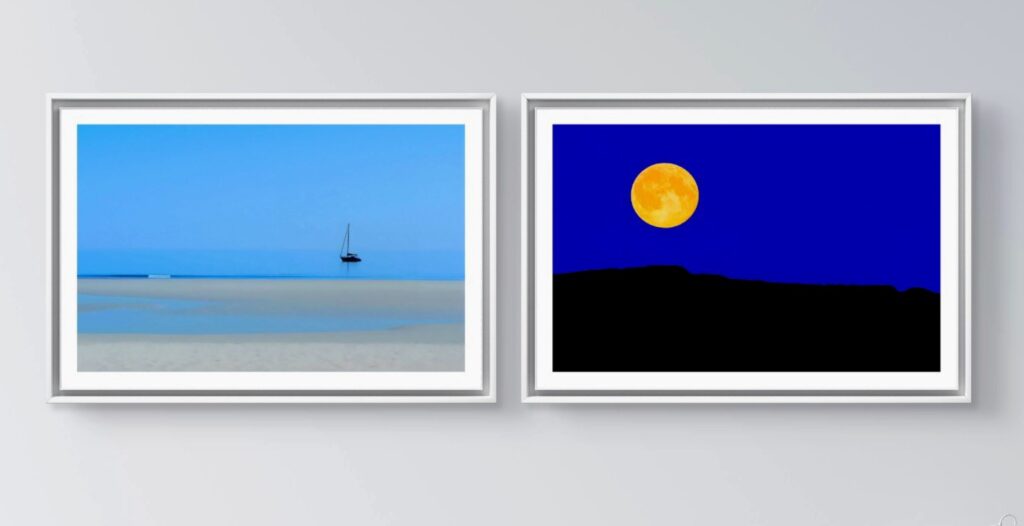
During the exhibition on Jomfruland near Kragerø in Norway, where I exhibited some of my work in June, there were four images in particular that immediately attracted attention.
Many adults were first drawn to Blue Silence and Golden Ratio.
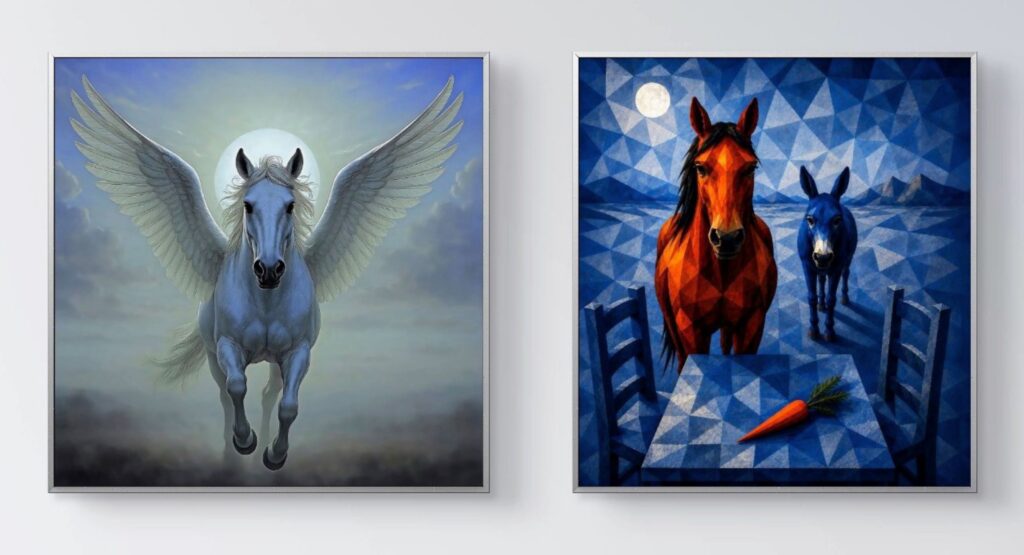
The younger visitors, however, tended to stop in front of Ascension and Carrot on the Table.
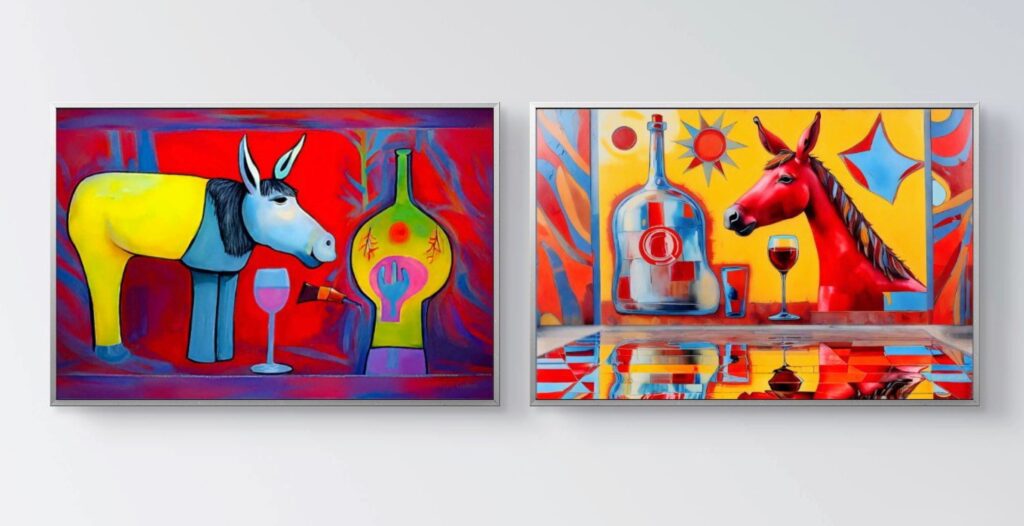
The children also liked the colourful images of horses, mules, donkeys and wine. Their parents, however, often pointed out that the images featured wine and therefore felt they were not suitable for children.
But let me explain why I believe younger visitors, from around the age of six and well into their twenties, were so quickly fascinated by Ascension and Carrot on the Table.
In Ascension, we encounter a white, winged horse coming towards us from a world somewhere between reality and myth. Where does it come from? Where is it going? It represents vitality and the determination to overcome obstacles, expressed through a clean and appealing visual language.
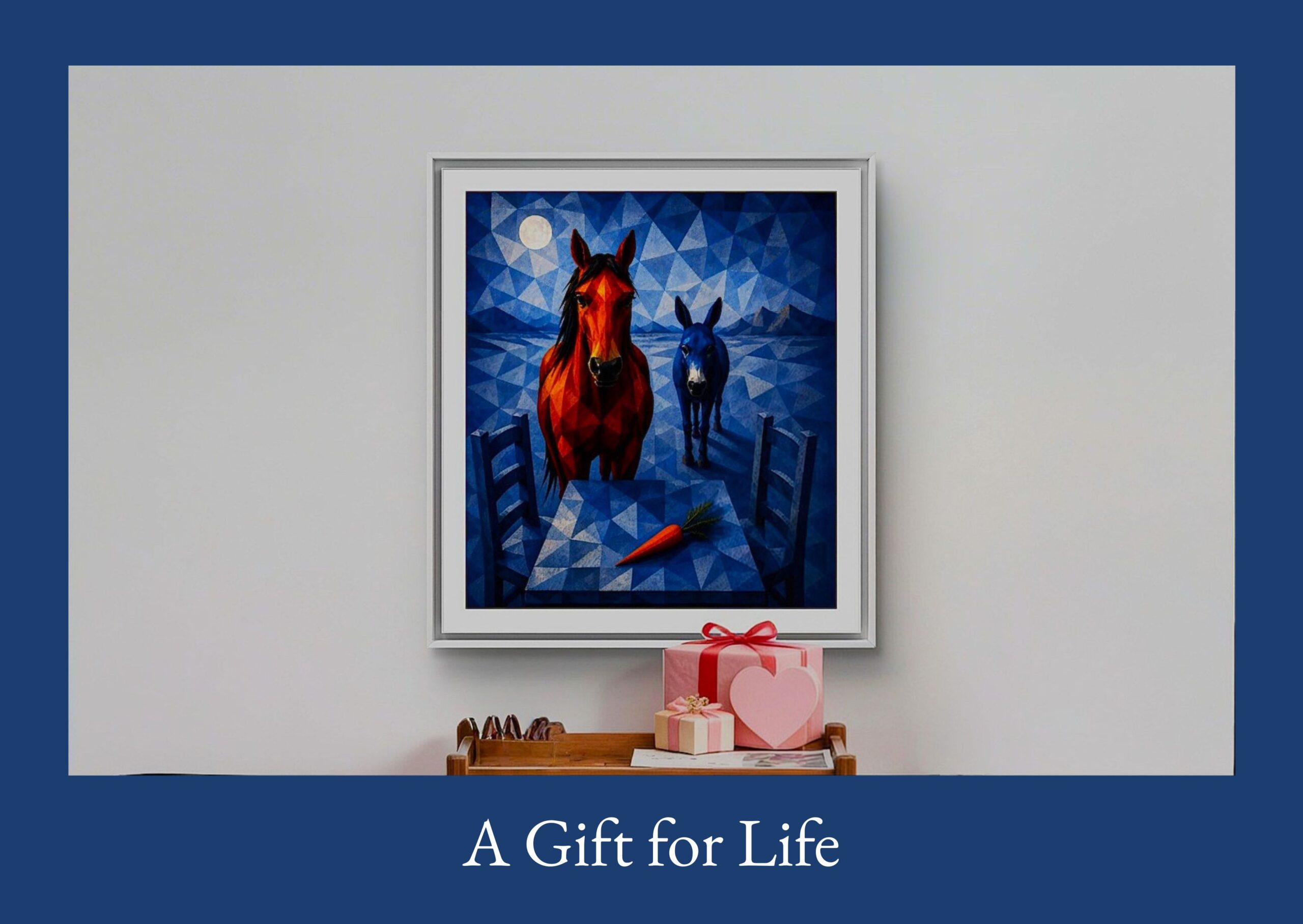
In Carrot on the Table, the situation is both simpler and more intriguing, while the image itself is executed to a high standard of craftsmanship. A horse and a donkey stand in front of a table with a single carrot. What has happened? Who does the carrot belong to? And what will happen next?
There is no right answer, but the imagination quickly takes over. Some thought the donkey would never get a bite of the carrot, while others believed the horse would not be quick enough and that the donkey would snatch the carrot right from under its nose.
And that is the point: an image that arouses curiosity can become a doorway into a world where children and young people are free to continue the story themselves. As they grow older, their experience of the image will change as well. What they see at the age of six is not necessarily what they will discover at sixteen or as adults.
But if a work of art is to accompany someone through life and one day be passed on to the next generation, craftsmanship and the quality of the materials are also important. An art print should not only look beautiful when it is first unwrapped. Ideally, it should be produced using materials and techniques that allow it to be preserved for many decades, even for generations.
That is why all available prints of these works from our gallery are Giclée prints on acid-free, museum-quality paper. They are intended to be far more than a gift for a child or young person. They are meant to mark the beginning of a lifelong relationship with visual art, produced to a standard that allows the works to remain in the family for generations.
Art can be a wonderful gift for young people when it sparks the imagination and is made to last.
Featured image by Eldar Einarson