In the beginning was the Word. Whether we believe in God or not, I believe this sentence contains a truth about who we are.
Our civilization began with the word. We could tell each other where to find water. Where the animals migrated. Where the enemy was. We could pass experience from one person to another and from one generation to the next. We no longer had to learn everything all over again. But the word has another, dangerous quality. It can manipulate reality, conceal it, change it, and ultimately replace it.
One of our earliest stories is about Babel, a place where everyone speaks the same language. They become powerful and decide to build a tower that will reach into heaven. But God intervenes and confuses their language, the project collapses, and the people are scattered across the earth. We know this myth as the Tower of Babel. It is about language, power, and hubris. In creating something extraordinary, we discover too late that we can no longer control its consequences – a motif that recurs in several of our ancient stories. They differ, but the underlying idea is similar: We acquire power, cross a boundary, and set something in motion that can no longer be controlled.
More than 2,400 years ago, the Greek historian Thucydides wrote about a civil war in which people who had lived side by side began killing one another. He described how words changed their meaning. What had once been recklessness and cruelty became courage. Caution became cowardice. An observation made more than 400 years before the beginning of our era. Thucydides recognized that when people are about to do something they previously considered wrong, they change the language they use to describe the act. And this reveals one of the word’s most dangerous qualities. Change the word, and we change our experience of the act. It no longer seems quite so terrible when we have words that make it sound less terrible.
Two thousand years later, an Austrian, Karl Kraus, described how the destruction of language contributes to the breakdown of society. He was a writer, satirist, and relentless critic of the press who lived in Vienna as Europe moved towards the First World War. Kraus described how propaganda, nationalism, sensationalism, and political opportunism gradually changed the way people perceived reality. He argued that newspapers, in their pursuit of headlines, were complicit. They opened the way for demagogues who played on emotions and cared nothing for the truth. Kraus showed us something fundamental about the demagogue. He does not need the truth, only the words that make us feel. When that succeeds, something strange happens to us. We stop asking: Is this true? We begin asking: Is this on our side – and perhaps, unconsciously: Does this serve me?
The newspapers Kraus criticized were only the beginning of something that exploded with radio, film, the microphone, and the loudspeaker. Suddenly, one person could speak to millions at once, something Hitler mastered. Before the Jews could be deported, they had to be described. Before they could be stripped of their rights, they had to be categorized. Before they could be killed, the majority had to learn to regard them as parasites.
The British writer George Orwell took the problem one step further in his novel 1984. The idea was frighteningly simple. If those in power can control language, they can also control the boundaries of what we are able to think. Remove nuance, and the world becomes simpler. Remove words, and criticism becomes harder to formulate. Orwell wrote about a world in which a few controlled the information that reached the many.
Then, a lifetime later, the opposite happened: Everyone got a microphone. The Italian writer Umberto Eco, who had spent his life studying signs, language, and how human beings create meaning, regarded social media with profound unease. As I understand him, it can be put this way: Social media allows the uninformed to occupy the same arena as the expert, and truth is often trampled in the process. The mechanism is interesting. The reach of the word exploded with the internet. The whole world became accessible, and social media did something even more radical: It turned all of us into broadcasters. Those who created history’s greatest democratization of knowledge forgot that the word is a double-edged sword. We democratized the lie as well, and now we are handing the sorting of words over to machines. The algorithm chooses for us, but it is not primarily designed to ask: Is this true? It has a different problem to solve: What keeps us on the page? What makes us click “like”? What makes us share?
Here modern technology encounters some very ancient creatures: us. Our brains are designed to respond to danger and help us survive. The algorithm is designed to discover what captures and holds our attention. Demagogues now have a tool for brainwashing that can tailor propaganda to each one of us. And they no longer need to find their audience. The machine finds it for them. Recently, another leap has occurred. We no longer even need to produce our messages ourselves, and the cost is approaching zero. Artificial intelligence can conjure up convincing lies in seconds and is already flooding the information stream.
And so we are approaching a strange historical point. Until now, information has been expensive to produce and difficult to falsify. Now the cost is approaching zero, while fabrications are becoming much harder to detect. Consider the asymmetry:
It takes seconds to produce a lie. It takes time and effort to refute it, and it may already have caused enormous damage before the correction catches up.
We have opened a door that cannot be closed, and our ancient stories contain all the information we need to understand how this will end.
The question is no longer: How do we reverse this development? But: What do we do when we have set in motion a development that cannot be reversed?
As the power of the word has grown, so has our physical power.
In 427 BC, a historian described how words drove neighbours to kill neighbours.
Today, words can trigger a nuclear war. We have the ability to destroy cities in an instant.
Words and weapons are a dangerous combination, and the lesson is there in plain sight. Those who wrote down our earliest stories had never heard of nuclear weapons. They had never heard of the internet. They had never heard of algorithms. They had never heard of artificial intelligence. But they knew human beings. That is why the ancient visions of the end of the world are not merely religious visions, but also expressions of a profound understanding of who we are and how we behave under pressure.
The next great catastrophe may arrive faster than our ability to understand that it has begun. Many people now sense that something is wrong, but reassure themselves that the collapse of civilization is something that happens slowly. Yet much now suggests that it could happen very quickly. Like the flood on the border between Nepal and Tibet. Before the catastrophe, the landscape still looks normal. We eat breakfast. We go to work. Children are on their way to school. A car crosses a bridge. The river flows where it has always flowed, and suddenly there is no longer any way to escape.
Our civilization may look robust. The planes are flying. Bank cards work. Hospitals have electricity. Shops receive their supplies. The internet works. The police report for duty. Salaries arrive in our bank accounts. And because all of this worked yesterday, we assume it will work tomorrow.
But almost none of these systems exists in isolation. What we call civilization consists of thousands of structures holding one another up. That makes the system extraordinarily efficient. But it also creates enormous vulnerability, and AI now emerges as a dangerous wild card. The warnings are becoming increasingly urgent. One of the pioneers of AI research, Turing Award winner Yoshua Bengio, now warns that AI is developing faster than both our scientific understanding and governments’ ability to control its development.
We have connected humanity’s ancient instincts to technology with global reach. We have connected the lie to the algorithm, the demagogue to billions of people, and conflict to weapons capable of destroying cities in seconds. And all it takes is a few words in the form of an order.
In the beginning was the Word. Is that how it ends as well?
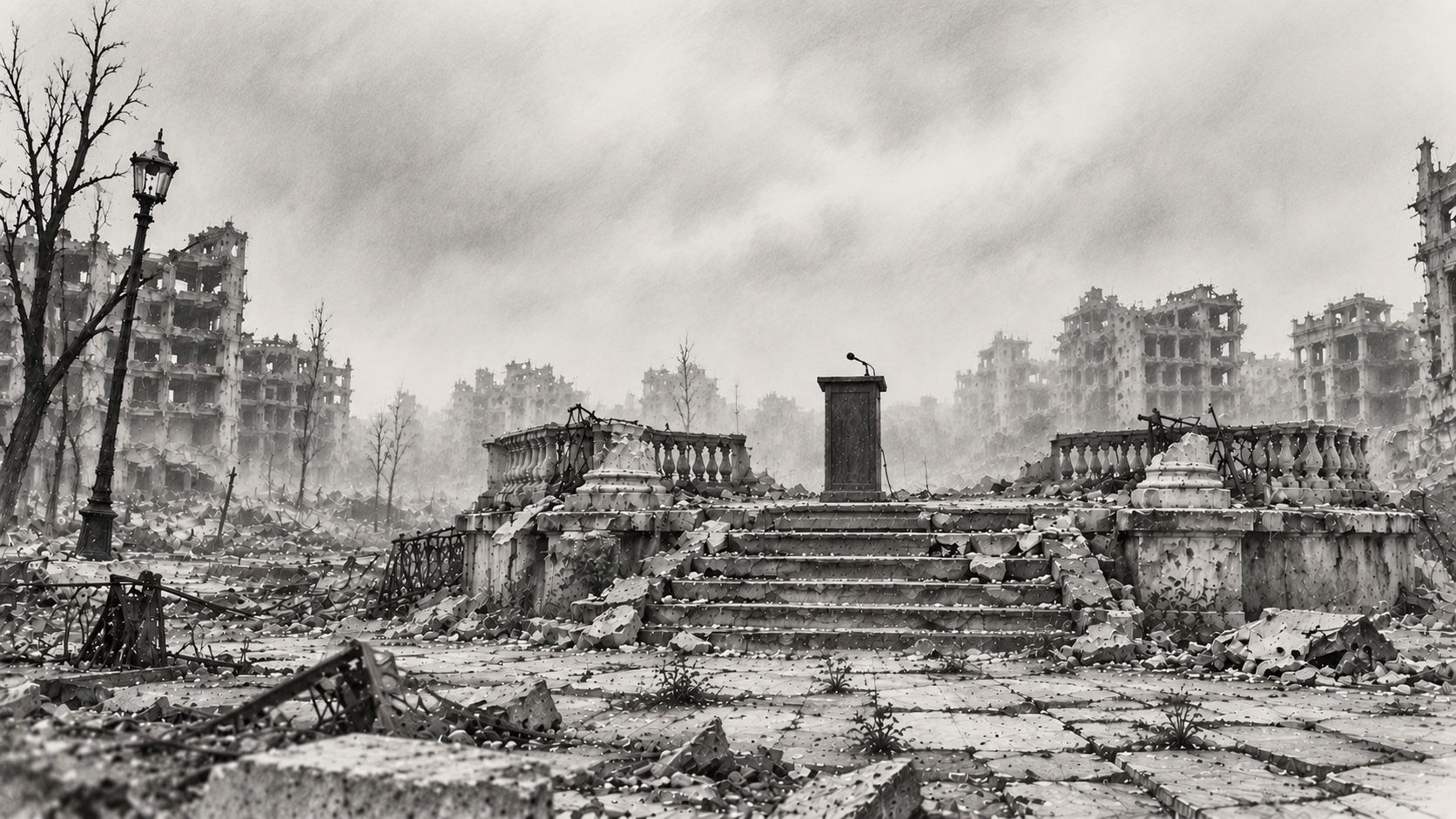
Featured image © Eldar Einarson