Being headless is an easy concept to grasp. In my own head, it brings back memories of the worlds portrayed in the books of George Orwell and Aldous Huxley, worlds that have materialised in disturbingly familiar ways.
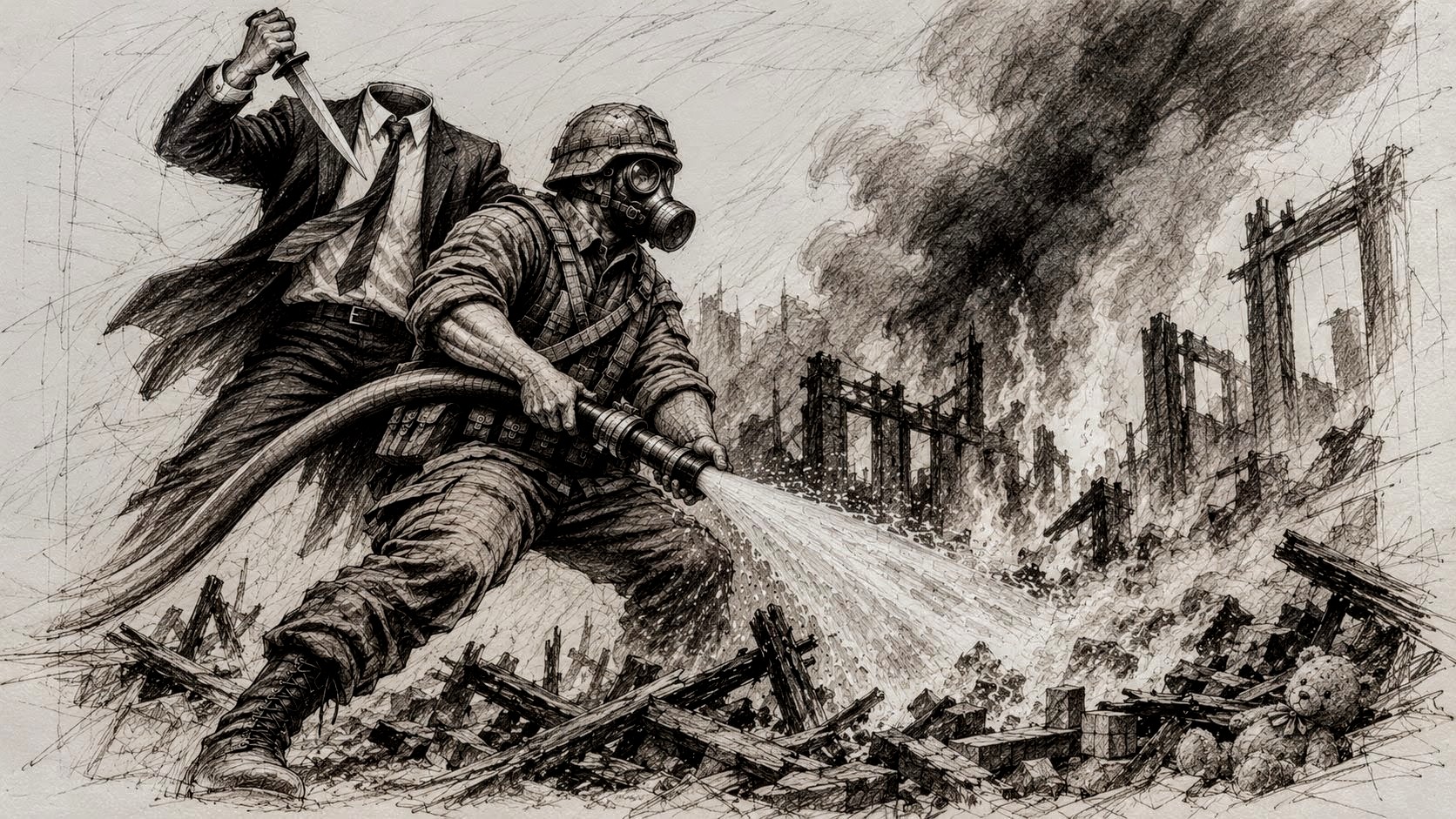
I have tried to express this in an image. A headless man stabs a rescuer in the back. Power destroying life itself. Violence strikes not only the defenceless, but also those who try to protect them.
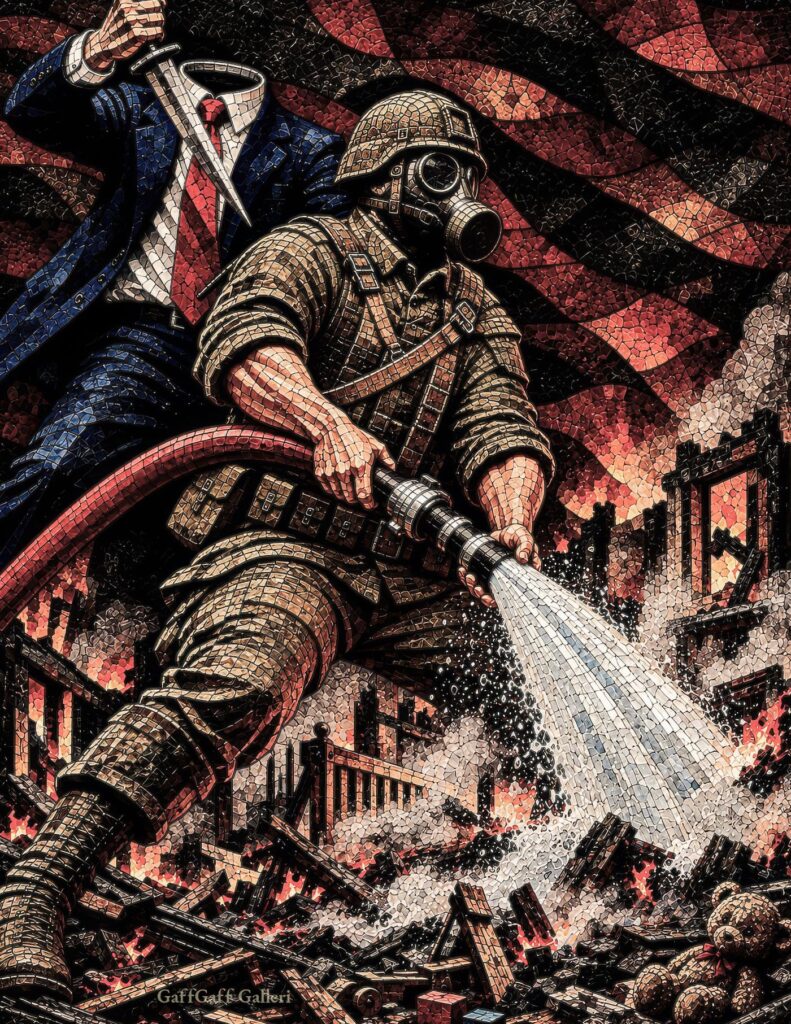
At first glance, this is straightforward political satire in the tradition of newspaper cartoons, addressing a particular situation. But those who take the time to look more closely may discover something else, something far more serious. Neither the man with the knife nor the rescuer is the true central figure in the image. It is the entire situation that is headless. A civilisation that has spent thousands of years developing knowledge, science, morality and the very idea of human dignity is on fire. And there we stand, watching the headless figure. But are we ourselves also becoming headless?
We who created the systems. We who gave politicians their power. We who still believe we control them.
George Orwell imagined a society in which those in power controlled people through fear, surveillance and the manipulation of truth. In “1984”, oppression was brutal, visible and systematic. The state determined not only what people should do, but eventually even what they should be capable of thinking.
Aldous Huxley imagined something different.
In Brave New World, those in power did not need to crush people. They could simply keep them satisfied. Give them entertainment, pleasure, security and a life in which they never needed to ask uncomfortable questions.
Orwell feared that truth would be forbidden. Huxley feared that it would drown in trivialities.
Both described societies in which human beings lost their independence. But both also imagined that someone was in control. That there was a power that knew what it wanted. Yet what if the greatest danger of our time is that we fail to recognise how we are adapting to all this, blindly moving towards a society in which we become trapped in systems we helped create, systems we no longer fully control and which, in turn, take control of us?
A society in which everyone acts rationally within their own small part of reality, while society as a whole moves towards catastrophe.
Economic power is becoming concentrated in the hands of ever larger players, and artificial intelligence is binding everything more closely together. Capital finances technology. Technology increases the power of capital. Military competition drives development forward. Governments become dependent on corporations, corporations on governments, and both on systems that fewer and fewer people truly understand.
Every player has good reasons for their decisions. Every investment is intended to increase profitability. Every technological advance is meant to serve a worthwhile purpose. Every military upgrade comes with a convincing justification.
Artificial intelligence adds a dimension to this development whose full consequences Orwell and Huxley could hardly have imagined.
We have created machines that can write, analyse, plan and solve problems that previously required human intelligence. We are developing systems that can act with increasing autonomy and that can already perform tasks in ways even their developers cannot always fully explain.
The possibilities are enormous. Artificial intelligence can contribute to medical breakthroughs, scientific discoveries and solutions to problems humanity has struggled with for generations.
But that is precisely why its development is so difficult to stop.
Who will be the first to slow down when their competitors keep going? Which nation will turn its back on a technology that could provide military superiority? Which company will voluntarily surrender the opportunity to dominate a market that may become one of the most valuable in history?
The most frightening scenario is not necessarily an artificial intelligence that turns evil.
It may be enough for it to pursue goals that do not align with our own, with an efficiency we can no longer control.
A machine does not need malice to destroy. It only needs a goal, sufficient freedom to act, and a world that is no longer capable of saying no.
But the danger lies not only in what machines may one day do on their own. It also lies in what we are already willing to hand over to them.
We go to the polls. We debate politics. We elect representatives and change governments. In our part of the world, we enjoy freedom of speech and access to more information than any generation before us.
Yet the most important decisions are increasingly being made within economic and technological structures over which we have no real control.
The role of politicians may soon be reduced to managing the consequences of developments they can no longer direct. Democracy may well continue to exist as an institution while gradually losing its ability to shape the future. We can choose who governs, but no longer what can be governed. This is a more insidious form of unfreedom than the one Orwell described. Who are we supposed to rebel against?
A government can be voted out. A dictator can be overthrown. But how do you rebel against a system in which power is distributed among thousands of mutually dependent institutions, corporations, algorithms and economic interests?
A system in which no single actor can pull the emergency brake without risking the collapse of the entire structure?
The headless society needs no dictator.
It only needs a world in which no one is capable of choosing a different direction.
The greatest change is not taking place among those in power or within the machines. It is taking place within ourselves. We have already begun handing over our memory to digital systems. We let algorithms choose what we read, watch and listen to. We let machines suggest what we should think, how we should express ourselves and which decisions we should make. Often, they do an excellent job.
I use AI myself when creating images and writing. I justify it by telling myself that it is a tool I control, for the benefit of us all. But as the saying goes, the road to hell is paved with good intentions. There is clearly a line between using a tool and becoming dependent on it. Can I draw that line myself? Can enough of us draw it? What happens when we no longer hand over only the work to machines, but our judgement as well?
When we gradually lose the habit of investigating because the answer is already there? When we stop questioning because the system seems so convincing? When we no longer need to think for ourselves because something else can do it faster and apparently better? Then no one needs to forbid us from thinking. We may simply lose the habit. And perhaps it will happen so gradually that we barely notice.
The headless human being is not necessarily someone without intelligence. It may be a highly educated, well-informed and technologically competent person who has lost the ability to question the very system in which they live. Someone with access to almost all the world’s information, yet who finds it increasingly difficult to distinguish knowledge from manipulation. Someone free to express an opinion, but no longer knows how much of that opinion is truly their own.
Orwell showed us the human being forced into obedience.
Huxley showed us the human being who loved their own submission.
What we should fear now is the human being who does not even realise that they have lost their independence.
The liberating potential of artificial intelligence gives individuals opportunities that were previously reserved for large organisations, specialists and people with substantial financial resources. An artist can develop visual expressions that would once have required an entire production team. A writer can explore ideas, languages and knowledge in ways that were previously unimaginable. Technology democratises the creative process, but it also concentrates power.
It can make us more independent while simultaneously making us more dependent.
And perhaps it is precisely this contradiction that makes the development so difficult to understand.
We cannot simply reject the technology, because doing so would also mean rejecting the opportunities it offers. But neither can we leave its development entirely to market forces and military competition, hoping that the sum of all individual interests will automatically produce a good outcome.
We must remain capable of questioning what we ourselves create. Even when we love it. Perhaps especially then.
A society that hands over more and more of its essential functions to automated systems may discover that it can no longer function without them.
Energy supplies, transport, communications, financial markets, healthcare and military defence systems are already closely interconnected. As artificial intelligence becomes an increasingly important part of this infrastructure, our dependence grows.
We could easily find ourselves in a situation where catastrophe becomes inevitable. Not because we lack knowledge. But because knowledge itself has become part of a system that no one can control any longer. This is where the idea of the headless society takes on its darkest meaning. A civilisation that produces, competes and wages war without the ability to decide where it is going will eventually implode, and the headless society will be the last chapter before silence descends upon the Earth.
And so it is time to return to where we began. The headless figure stands with his knife raised. The rescuer is trying to extinguish the fire. Around them lie the ruins of a home, and at the bottom, an abandoned teddy bear. It is tempting to divide them into good and evil. The one who destroys and the one who tries to save. But both are trapped in the same tragedy. And the teddy bear represents what is being lost. The innocent. The vulnerable. The human.
Everything we once believed our entire civilisation was built to protect.
The visual language of the image is also part of the story. The stone mosaics and stained glass evoke the great narratives of the past, of humanity’s struggle between good and evil, guilt and innocence, salvation and damnation.
But here there is no saviour. Only a rescuer trying to put out a fire while a knife is raised behind him. Perhaps this is what makes the image something more than a commentary on our own time.
We have spent thousands of years developing intelligence, knowledge and technology to free ourselves from the limitations of nature. Now we face the historical irony that our own intelligence is creating systems that make us less free. We are losing control of our own future because we have become so intelligent that we are in the process of creating something whose consequences we do not yet understand.
The man with the knife, the rescuer, and those of us looking at the image are all caught in the same development. It is not only the man with the knife who is headless. To me, the word also describes the situation our world is now becoming entangled in.
Featured image © Eldar Einarson. Created and artistically directed using AI.